Introduction

My name is Ignacio Flores (Candidate number: 9049) and I am working in Group 2 with Mario Louka, (Candidate Number 9099) and Eddie Rowe (Candidate Number 9147). To access my work, please click on the three labels on the right named A2 Research and Planning, A2 Construction and A2 Evaluation.

Group 2 Music Video

Digipak

Digipak:

Website

Link to the website:Link to the website:


Tuesday, 31 March 2015

Evaluation Question 1: In what ways does your media product use, develop or challenge forms and conventions of real media products?

The opening sequence develops and challenges the forms and conventions of action films. Although most of our opening sequence adheres to the conventions of the genre, we aimed to challenge some character representations and stereotypes.

The most useful real films which inspired us were: 

  • The James Bond film series
  • The Usual Suspects
  • Se7en
  • Taken
  • Rounders
  • 21
  • Drive
An outline of our plot is: Blake, the protagonist who is an ex-policeman,  has had his partner, Rachel, kidnapped by a criminal gang. The film is about his struggle to find out where Rachel is and getting her back. In order to get to her, he enlists the help of an ex-colleague from when he used to work with the police. The opening shows him trying to get this colleague, Jennifer (Jen), to help him find out where Rachel.

Form


We aimed to make our sequence
similar to The Usual Suspects 
A typical feature of an opening sequence is opening credits, including a distribution company, production company(/ies), directors' and actors' names, names of others involved in the production and the title of the film. Usually, after this there is an introduction to the setting and characters. This order can be switched around. For this we took inspiration from the way the opening scene was done in "The Usual Suspects", as we really liked the way in which the titles were shown, overlayed on the background. However, since our opening sequence could only be around 2 minutes long, we did not have the luxury of being able to separate these two; we decided to have a short part of our sequence having the main credits involving no shots of the characters, the rest of them were overlayed onto the scene as Blake and Jen spoke to each other. The music in our sequence was used to build up suspense for the shooting at the end, so one of our group members composed his own music to fit this. Usually there isn't something so eventful during the opening sequence, but I will talk about this later on under Narrative Structure.

Genre

Characters - There was the typical male protagonist in our film, however his partner is not stereotypical, as she is a woman and also not the 'damsel in distress' type. Also, although at first we pictured Blake to be portrayed as a strong alpha male type of character, like James Bond, we later changed him so that the audience could sympathise with him; we showed him to be a good guy doing bad things because there was no other choice, similar to Bryan Mills from Taken, who was a father trying to rescue his daughter.


Events - The shooting is probably the most action related part of our sequence, it is an unexpected surprise which involves the deaths of two characters very early on in the story. Many Action films we looked at had scenes which involved shoot outs.
Shooting scenes from both Drive and The Usual Suspects
Themes - There was a very conventional story in our film, where a hero is trying to save a princess, Blake is trying to Rachel, his fiancée. 
A shot from Drive featuring low key lighting
Mise en scene - the lighting was very low key and we used the lighting to cast shadows over characters' faces. This was very much a neo noir element, and was somewhat similar to shots in 'Drive'.


Narrative Structure


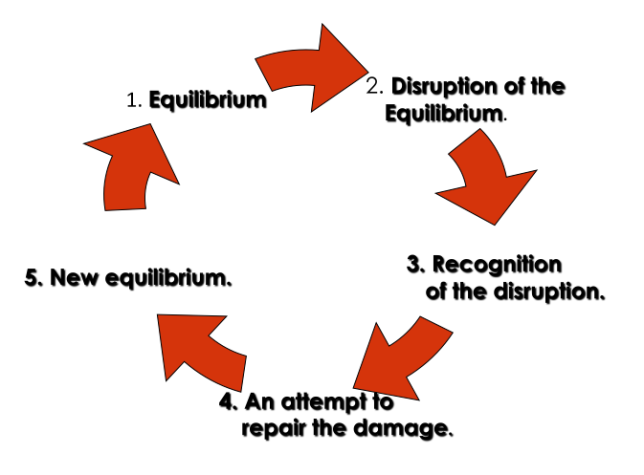
Todarov's theory of equilibrium is shown in the diagram to the right. Many movies follow this structure, for example 'Se7en' starts off with a new detective joining an investigation, so he is just doing his job as he normally would. The disruption is the series of strange murders, this is solved by the detectives who find the killer and then kill him, creating a new equilibrium. Our film however does not follow this sequence of events. It starts off in the disruption of the equilibrium and it also shows a flashback of a time during equilibrium. The showing of a different time than what is going on was partly inspired by 'The Usual Suspects', where the opening scene is actually what happens at the end of the film.

Bathe's five codes also influenced our project. Hermeneutic code was used to build suspense throughout the first half of the sequence, in shots such as the tense looks from the thugs and the setting, which along with the darkness surrounding the table made it seem very mysterious. The Semic code of the poker game happening in this mysterious area also makes the setting seem potentially dangerous.

Propp's Character Theory also influenced our story as it affected all of the characters in the sequence, and some of the characters outside of it. Blake was the 'Hero' who had to save the 'Princess', Rachel, from the villains who had kidnapped her, but he is also a bit of an Anti-Hero, as he is willing to do bad things in order to get his fiancée back. Examples of 'Heroes' in other films would be James Bond from Casino Royale, or David Mills from Se7en. A 'Princess' from other film could be Kim Mills from Taken. Jen acted as the helper to Blake, saving him from the thugs and presumably helping him throughout the rest of the film; an example of a helper in another film is Shannon in Drive. The thugs were minor antagonists for just the opening sequence, providing an obstacle for the hero.

Style


Overall, the style was mostly neo-noir, as I think we went too far past 'thriller' and turned the opening sequence into a more crime-focused scene. The low key lighting which is a staple of Noir and Neo-Noir films was strongly present during the whole thing. I think it was similar to the look of 'Drive' and 'Only God Forgives' since those films also used a lot of low key lighting throughout. The minimalist design of the setting also contributed to this as well, adding more mystery to the location of where the characters were.


Evaluation Question 2: How does your media product represent particular social groups?

The main focus of representation in our opening sequence was Gender Representation. We designed our characters around how we wanted them to be represented to our audience.

Our main character, Blake, is portrayed in a way that both conforms and breaks away from stereotypes. There is a sense of bravado about him, especially when he starts talking somewhat threateningly to Jen saying "I will do everything in my power to find these people". He also seems quite unintimidated by the location he's in, despite the possible threat of the thugs. This fit in line more with the stereotype of the alpha-male being the protagonist of an action film, such as James Bond.


We also decided to include some other features to the character to make him more three-dimensional and also more sympathisable to the audience. He is shown to only be doing what he is doing in order to save his beloved fiancée. Furthermore he is visibly shaken by the killing of the two thugs and stands in shock as Jen walks away. Blake is also shown to be of a middle class background, as evidenced by the juxtaposition of his formal clothing in comparison to the thugs, making him seem quite out of place.

The costumes of our protagonist and
others greatly contrasted
On the other hand Jen is very much a challenge to the way women are usually portrayed in action films. She is neither a woman who is needed to be saved, or a love interest for the protagonist. In 'Drive' the two women who women who had main roles in the film were Irene and Blanche, one was protected protected by the main character, while other deceived him into a trap.


We decided that Jen should be portrayed as a strong, independent character and this is done through different ways. Firstly her costume is a lot more suited to the setting, her leather jacket makes her look tough and fit in with the thugs. Secondly she shoots the thugs without hesitation and does not seem to be that affected by having shot them, making her seem a lot more stronger than Blake in comparison. Lastly, during the exchange between Blake and Jen, she very much dominates the conversation; she is in a position of power, as she has the information that Blake needs, but doesn't give this info away for nothing - she wants to know why she should help him in the first place, perhaps connoting that she only looks out for herself, rather than relying on and helping others.


Evaluation Question 3: What kind of media institution might distribute your media product and why?

The distributor of our film would be Universal Pictures. This is because they have a history of distributing a wide range of films from different countries, for example The Theory of Everything is a British film which was distributed in the UK by them.


In our research we found that Dark Castle Entertainment, an American production company which produces similar films to ours like RocknRolla, was a subsidiary of Silver Pictures which had a 5 year marketing and distribution deal with them. We decided to make our film in association with Silver Pictures, as this would attract fans of their films, while also providing us with help from them in the full movie.


Our production company, FRP Studios, is a fairly small company with no previously released films, so if Universal did decide to distribute our movie, we may not be given as high funding or marketing budgets as a bigger film, such as 'The Dark Knight Rises' (distributed by Warner Bros. Pictures); however the fact that we still get funding is great either way. This way we don't have to rely on other
sources of funding such as crowdfunding, the way the makers of the film 'The Knife That Killed Me' raised the money to premiere the film, although the distribution rights for the UK have been bought by Universal Pictures UK.

As our film is British, our movie will probably have a limited release in British Cinemas to see if it is successful or not. If it is successful the film will probably get a staggered global release, and different companies will buy the distribution rights for the film in their respective countries. We may also get offers for the distribution rights online from streaming services such as Netflix or LoveFilm. Finally, the movie will have DVDs and Blu-ray discs distributed worldwide some time after it has stopped screening in cinemas.

Evaluation Question 4: Who would be the audience for your media product?

Before we began the project we conducted some research into which genres were popular and with whom they were popular. We conducted a small survey in school asking people about their preferred movie genre. We found that the action genre was liked by the most people across all of the ages interviewed, with thriller also being popular. However, this research was quite small scale and was also limited to students aged 11-18. We did further research and found this chart from a journal of audience and reception studies. This chart backed up our research as it showed that both action and thriller were very popular among a lot of ages, compared to other genres, so we decided to stick with this combination.
The chart we found.

So we decided that our target audiences would be Fans of action films (Primary), 15-40 year old men and women (Secondary), British Audiences (Tertiary)


Because our core audience was so diverse, we appealed to their unifying feature, their love of action films. They would like similar movies such as Non-Stop, Sin City and the James Bond franchise. Because they are specialists in action movies, they will know the conventions of these films and will be more informed to judge on whether or not the film is a good action movie. We had to make sure our production was of a high quality so that we could appeal to them.

Evaluation Question 5: How did you attract/address your audience?

First of all, our target audiences are:
  • Fans of action films (Primary)
  • 15-40 year old men and women (Secondary)
  • British Audiences (Tertiary)
One thing which helped us to attract my audience was the uses and gratification theory. This included four reasons as to why someone would watch or read something: Escapism,  Interaction, Personal Identity and Surveillance.

Escapism was probably the most prominent gratification in our final product; our film opening had a quiet surreal look to it and the setting was definitely out of the ordinary - it features an ex-cop trying to get back his kidnapped fiancée at a back-alley poker game. The film also alludes to some action later on in the film, with Jen and Blake breaking into a police station.

I think the action in our film, mainly the shooting, would have definitely appealed to all of our target audiences as through our research we found that action was the most popular genre by far, even though it was slightly skewed towards men than women. The shooting, although it was somewhat provoked, was meant to be a surprise to the audience; Jen just had to feel a sense of threat and she would shoot these two men, making her seem as an extreme sort of character - although this could have confused our audiences, which I will talk about later in this post.


I think the characters will be very relatable to some areas of the audience. Blake, is a middle aged, middle class man, and is supposed to appeal to the masses. Jen on the other hand breaks the conventions of female characters usually being damsels in distress, and is a strong female character who can look out for herself. Through her tough personality and actions she is supposed to be aspirational for the females in our target audience. Both of these characters are also crucial to the development of a strong narrative in our film, which I think will also be something that will draw people in, particularly the older end of our target audience.

We conducted a survey to gather information on audience feedback. First we asked what the respondents age and gender were. As expected, males watched the film more than females; this is because although action is a genre with a wide appeal, it is slightly skewed towards men. The ages we got responses from were in between 13 and 55, with the majority being 13-24. The age results did not reflect the previous data we had found while doing research, but this is probably due to the small scale of our research in comparison; as we were limited to the people we could ask, we were going to get more younger people, since we knew more younger people than older people.


previous data we                                Two pie charts, showing our newly gathered info
 had found


We also asked them what they liked about the film and got these responses:


The feedback was positive overall, with respondents praising many different aspects of the film. I think this is proof that we have managed to successfully appeal to our target audience; however if I were to do this project again, I think I would probably make the plot more clear, since as it starts in the middle of an event (Blake at a poker game) it may confuse the audience.

Evaluation Question 6: What have you learned about technologies from the process of constructing this product?

I learned things relating to both hardware and software during the course of the construction of the film opening.

Hardware
  • I used the Canon Legria HF G30 camera during the filming of the project.  I had used this type of camera before during GCSE, so it was quite easy to use; however I still learnt new things which I could do with it, such as changing the focus while recording to do a focus pull, this was a very cool new thing which I was able to try out during the shoot.

  • The Camera Jib was something which I had never used before, though I was somewhat familiar with the concept. Using this piece of equipment, we were able to get shots from very high angles. However, despite the usefulness of this piece of equipment it also took a long time to set up and because of this, we weren't able to use it in our back up shoot as we were so pressed for time.

  • Lighting- we used both lights on stands and studio lights. These were both used to a good extent during our shoot; the spotlight from the studio lights provided the lighting for the table, while the other lights allowed us to light up actors individually as we saw fit. The lights on stand were probably one of the most useful pieces of technology we used since it allowed us to light our scene very well, which helped us connote the neo-noir genre.


Software
  • The software I used the most was Adobe Premiere Pro, and I definitely learnt a lot about how to use it. I had used it during GCSE, so I was able to place shots and cut them with relative ease. The real learning I got in relation to this software was grading, which was done with ProcAmp. This allowed me to change the contrast, brightness and saturation of shots, and through experimentation I eventually became confident in using this to alter our sequence. A disadvantage of Premiere Pro was that we were only able to use it in school - although Eddie and I did have it at home, it would have been a hassle to have been constantly moving different versions of the edit and showing it to the other members all of the time. This limited the total time we could edit and also meant that we usually had a very tight editing schedule.

  • The other piece of software I used was Adobe After Effects, which we used to add special effects into our shots. I had never used the program before, so everything was quite new for me, thankfully Eddie already had some experience with it and was able to help me use it. This software was quite flexible, as it allowed us to both add in visuals such as the flash of a gunshot and allowed us to manipulate the lighting as well. Furthermore I found that we could put the edited shots straight into Premier Pro, showing the synergy the two products had with each other.


Evaluation Question 7: Looking back at your preliminary task, what do you think you have learnt in the progression to a full product?

The Briefs

The brief for the prelim task was as follows:
"Continuity task involving filming and editing a character opening a door, crossing a room and sitting down in a chair opposite another character, with whom she/he then exchanged a couple of lines of dialogue. This task should demonstrate match on action, shot/reverse shot and the 180 degree rule."

We followed these, with the our editing of the footage mostly focusing on keeping continuity between shots.

My finished version of the continuity task:


The brief for our film was:
"To produce a 2 minute opening for a fiction film. All video and audio material must be original, produced by the candidate(s), with the exception of music or audio effects from a copyright free source. It should be clear from your sequence who the target audience is. "

Obviously the  brief for our film was a lot more open, and we had a lot more choice when making it as we could freely decide what was included in our film. I think the more complex nature of our later project made us plan it in far more depth than our prelim task.

Pre-Production

For the prelim task, we barely planned it. We had a limited number of people who could act in it and we did it in lesson time, so we had a location and time for the shoot. However, when planning for the film brief, there was much more to be done.

First of all we had to take into account the genre, since we also had to have a target audience; this made us first do some research, finding which genre would be most popular. We also did research on the narrative of films in the similar genre of which we chose, as the narrative would have been far more important than in the prelim task.

When planning the production of the opening sequence, we also went much further. There was much thought put into things such as the actors and location. We also planned the shoot in more detail, making a shootboard, shootboard and an animatic beforehand.
Our shoot-board had a lot pf details on it

Production

There were many differences between the production of the prelim task and our main project. This mostly had to do with the complexity of the shoot. In the filming of the film, we had much more things to take into account; for example we had to set up lighting, we had to set up the scene and props and we also had to direct our actors a lot more. We also had to do a lot of organisation relating to the location, as it was in school and we would be working mostly after school had ended.

I think that we learnt a lot from the prelim task, which was then implemented into the production of the film. For example the focus on continuity made us a lot more wary of possible continuity errors. We also used the experience of having shot conversations from different angles to our advantage, this formed the basis of many of our shots which involved dialogue. The different shot types we used in the prelim also affected how we shot in our main task, e.g. in one shot of our prelim there was a lot of empty space to the side of one character, this made us use more compact framing in the film.

Continuity in our prelim
Continuity in our film


Post-Production

In the preliminary task we only had to place the shots in the shots into the sequence in the right order, cutting them so that they were the right length, while also making sure that there were no continuity errors. During the editing of the main project we did this and more; we had more software available at our disposal and we used Premier Pro in more depth.

In Premier, we made titles, added in transitions between some of the shots and also used ProcAmp to change the contrast, brightness and saturation of shots - this was very useful for us to produce a more neo-noir type of atmosphere, with low key lighting. Premier Pro was also used to add in and manipulate sound; for example, making the background music louder or quieter at certain points.


In Adobe After Effects we added in special effects to our shots, such as the guns' muzzle flare effects. We also used 'Masking' in after effects, a technique which let us change the lighting of certain areas of a shot, which proved to be very handy when we used shots from older shoots, which had different lighting.

Masking in After Effects